If you have ever tried to bake three casseroles, a tray of rolls, and “just one more thing” for a potluck, you already know the panic: one dish wants 350°F, one wants 425°F, and the lasagna is still chilly in the middle while your topping is getting a little too confident.
I call it Oven Tetris, and the good news is you do not need a second oven or a culinary degree. You just need a plan: which dishes can share a temperature, which ones can be held, and how to stagger start times so everything lands hot and happy.
The big idea
When dishes have different baking temperatures, you have four levers to pull:
- Group dishes with similar temps and bake them together.
- Compromise on a middle temperature and adjust time.
- Stagger start times so high-temp items go in later.
- Hold finished casseroles safely so the oven can switch temps.
Most of the time, the winning move is a mix of all four.
Step 1: Sort by temp
Before you touch a knob, list each dish with three details: target temp, bake time, and whether it is covered for most of the bake.
Quick temperature guide
- Low and slow (325°F to 350°F): creamy pasta bakes, most casseroles with a lot of dairy, lasagna, enchiladas, breakfast strata.
- Middle (375°F): many veggie casseroles, baked mac and cheese, and reheating fully cooked casseroles back to serving temp.
- Hot (400°F to 450°F): roasted vegetables, sheet-pan sides, biscuits, garlic bread, anything you want browned and crisp.
If you can group two or three dishes within 25°F of each other, you are already winning.
Step 2: Pick a base temp
If I am baking multiple casseroles, I pick one temperature that will handle the majority of the oven time. For potlucks, that is usually 350°F or 375°F.
When 350°F wins
- Two or more creamy, cheesy casseroles
- Anything starting cold from the fridge
- Dishes that bake covered most of the time
When 375°F wins
- A mix of casseroles plus one browned topping situation
- You need a little extra push to finish faster
Then we adjust the outliers.
Step 3: Temp adjustments
Here is the home-cook math I use. It is not meant to be laboratory perfect. It is meant to keep dinner on time. Treat it as a starting point, then let doneness cues and a thermometer make the final call.
If you bake lower
Often, adding 10 to 15 minutes per 25°F drop works for a typical 9x13 casserole that is not super thin. Example: A 400°F dish baked at 375°F may need an extra 10 to 15 minutes.
Big caveat: dense casseroles, fridge-cold dishes, and glass pans can need more than that.
If you bake higher
Start checking about 10 minutes earlier per 25°F increase, especially if the top is exposed. Higher heat can dry edges faster, so keep things covered longer and uncover only at the end for browning.
Covered casseroles are forgiving
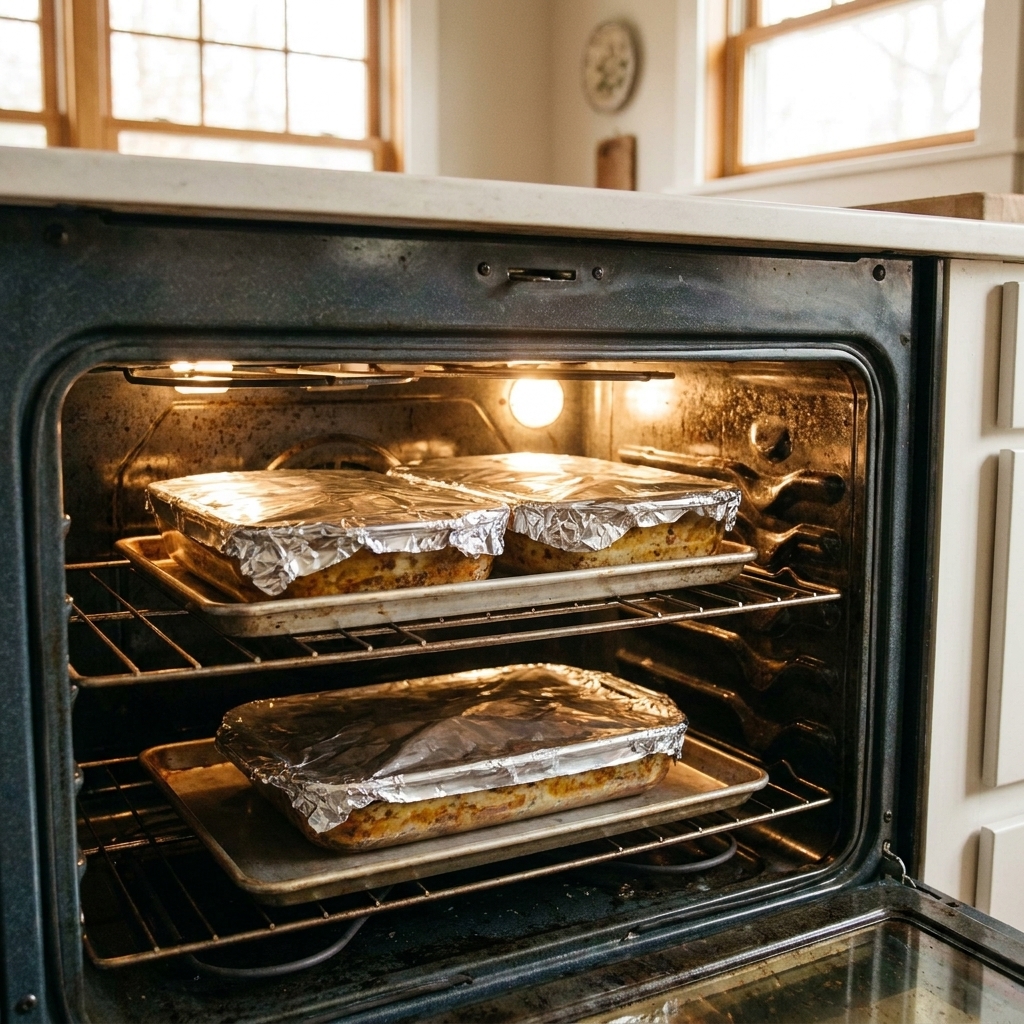
A casserole covered tightly with foil for most of the bake behaves nicely in a shared oven. It is protected from drying out, and you can move it up or down a rack without drama.
Do not force these
- Delicate custards (some breakfast bakes, bread puddings): they can curdle or weep if pushed too hot.
- Quick breads or souffle-ish dishes: they are pickier about heat and timing.
- Anything you need truly crisp (like tater tot tops): it might require a planned finishing blast of heat.
Pan material matters
Glass tends to heat more slowly and can run a little behind on timing, especially from fridge-cold. Metal usually responds faster and browns more readily. If you are mixing pan types, assume the glass dish may be the one that needs extra time, and confirm with a center temperature check.
Step 4: Rack setup
If your oven has two racks, use them. If it has three, resist the temptation to fill every inch with tall casseroles unless you can keep air moving.
Simple setup for 3 to 4 casseroles
- Rack positions: upper-middle and lower-middle (not the very top or very bottom).
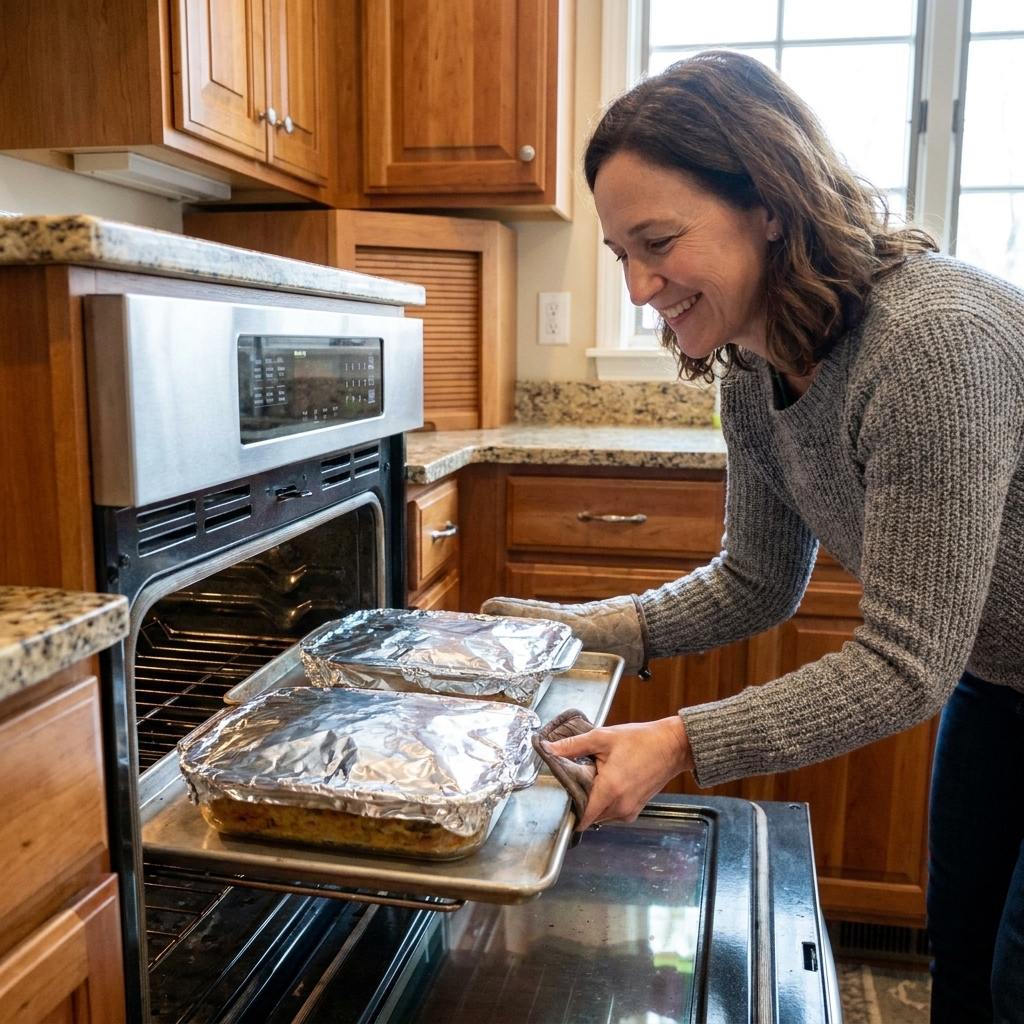
- Sheet pan trick: place each casserole dish on a rimmed sheet pan. It catches bubbles and makes sliding easier.
- Leave breathing room: at least 1 inch around each dish if possible so heat can circulate.
Rotate on purpose
Most ovens have hot spots. Halfway through the bake, do a quick rotation:
- Swap top and bottom racks
- Turn each pan front to back
Do it fast, then close the door. A long door-open moment can drop oven temp more than you think.
Step 5: Timing plan
Here is the schedule I use when I have multiple dishes with different temps. Adjust times to your recipes, but keep the order.
1) Start the longest bake
Usually that is lasagna, baked ziti, enchiladas, or a breakfast casserole. Get it in first, covered tightly.
2) Add the next dish later
Add the second-longest bake 15 to 30 minutes later. This keeps the oven door opening from hitting your first dish right at the beginning when it is trying to climb in temperature.
3) Save hot-temp items for the end
Garlic bread, rolls, and anything that needs 425°F belongs at the finish line. They bake quickly and do not hold as well.
4) Switch heat once
If you must switch temperatures, do it a single time near the end. Example: bake everything at 350°F, then bump to 425°F for the last 8 to 12 minutes to brown toppings and toast bread. Keep a close eye, because sugars and cheese can go from golden to too-dark fast.
5) Use the rest window
Most casseroles are better after a rest. That rest is your secret holding time:
- Lasagna: 20 to 30 minutes before cutting is ideal.
- Cheesy pasta bakes: 10 to 15 minutes helps them set.
- Meaty casseroles: 10 minutes keeps juices from running everywhere.
Step 6: Holding safely
This is where busy-family casseroles shine. A hot 9x13 has a lot of thermal mass. It stays warm longer than you think if you treat it right.
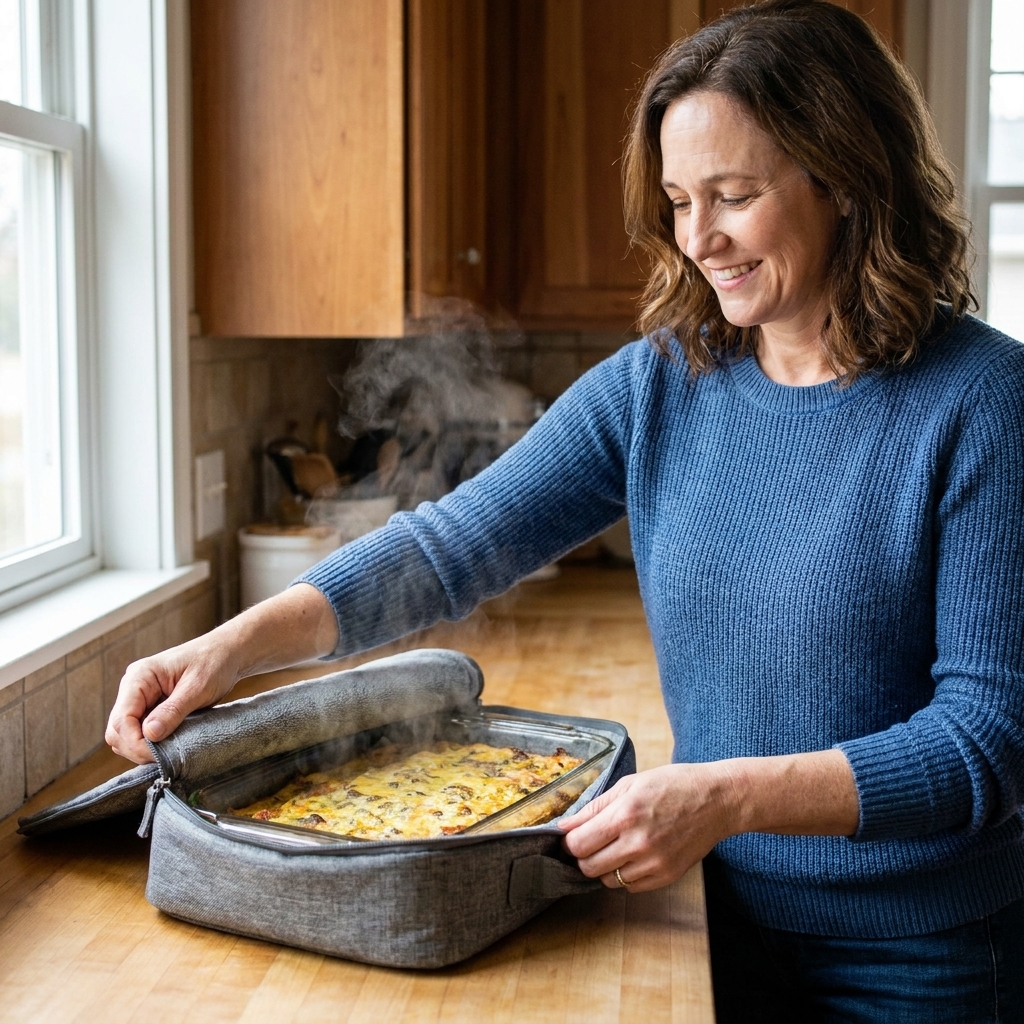
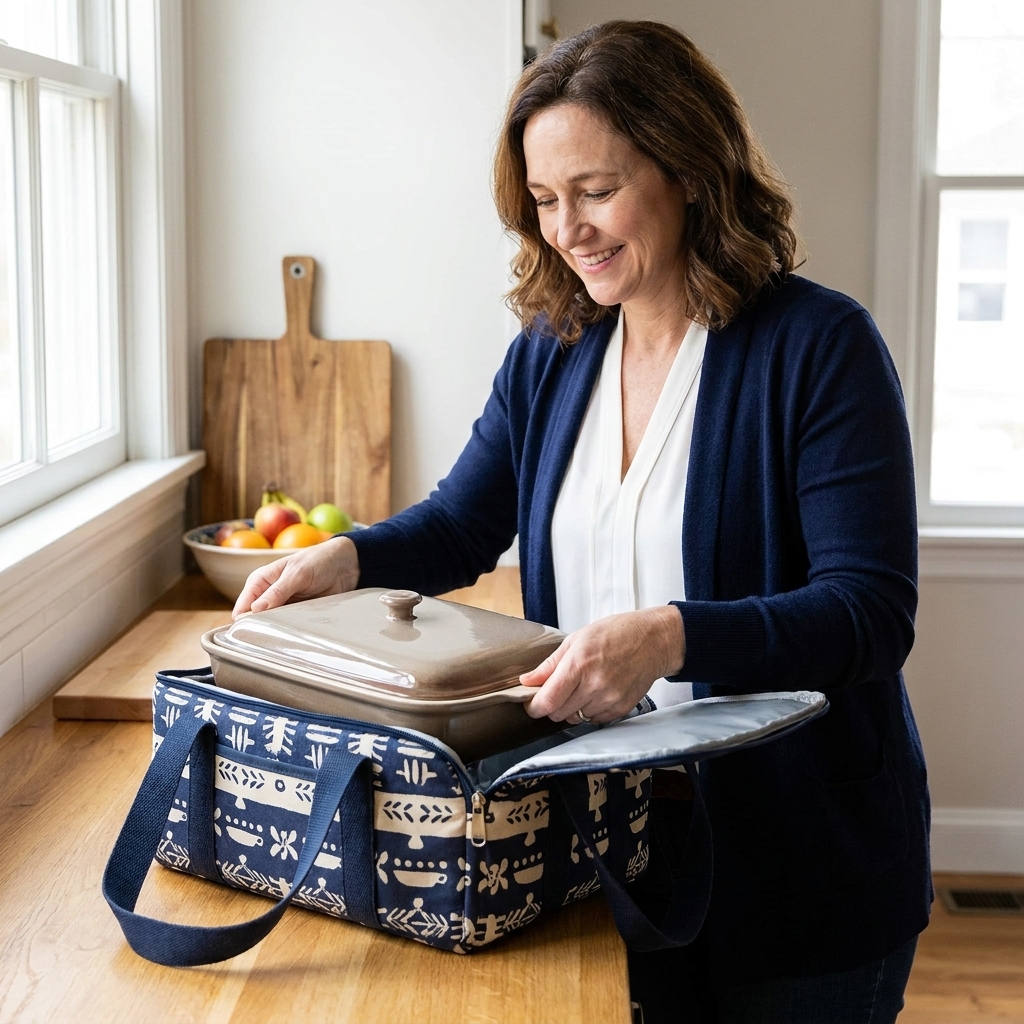
The towel and foil hold
Best for about 20 to 60 minutes, assuming the casserole comes out piping hot.
- Leave the casserole in its dish.
- Cover tightly with foil.
- Wrap the whole dish in a thick towel.
- Set it in a turned-off microwave or a cooler (no ice) to reduce drafts.
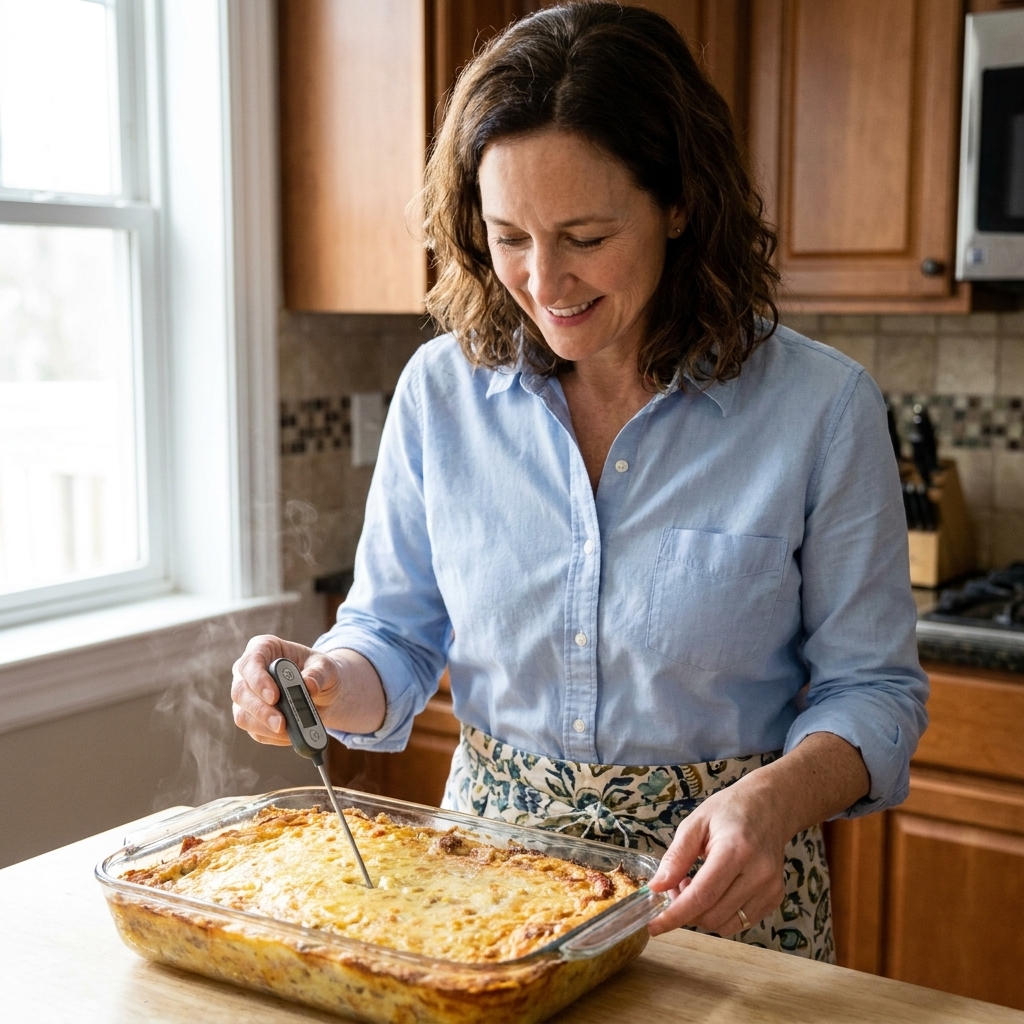
If you are pushing the far end of that hour, use an instant-read thermometer to spot-check the center. If it drops below 140°F, reheat it back to 165°F before serving.
Warm oven hold
Best when your oven can sit at 170°F to 200°F. Cover casseroles with foil to prevent drying and hold up to about 1 hour without quality taking a big hit.
Because “warm” settings can be wild from oven to oven, an inexpensive oven thermometer is worth it here. You want warm, not baking.
Food safety note
For longer holds, you want hot foods to stay hot. Many home guides say 140°F for hot holding, and some food code guidance uses 135°F. Either way, the practical move is the same: use a thermometer and keep dishes out of the danger zone. If a casserole cools too much, reheat to 165°F for safety.
Doneness checks
When you are juggling multiple dishes, the nose test is not enough. Use a couple of simple cues.
For most casseroles
- Edges: gently bubbling at the sides
- Center: hot and set, not cool and loose in the middle
- Top: melted and glossy, not pale and stiff
If you have a thermometer
- Mixed casseroles with meat, eggs, or that are being reheated: aim for 165°F in the center.
- Cheesy pasta bakes without meat or eggs: 160°F to 165°F is a great quality target, but 165°F is never a bad idea when you are feeding a crowd.
Three Oven Tetris lineups
Lineup A: Potluck classics
- Dish 1: Lasagna (350°F, 60 to 75 min, covered then uncovered)
- Dish 2: Green bean casserole (350°F, 30 to 40 min)
- Dish 3: Garlic bread (425°F, 8 to 12 min)
Plan with timeline cues:
- T minus 75 min: Lasagna in at 350°F, covered.
- T minus 40 min: Add green bean casserole.
- T minus 15 to 20 min: Pull casseroles as they hit doneness. Hold covered.
- T minus 10 min: Raise oven to 425°F and toast garlic bread right before leaving.
Lineup B: Breakfast crowd
- Dish 1: Sausage breakfast casserole (350°F, 45 to 60 min)
- Dish 2: Cinnamon roll casserole (350°F, 30 to 40 min)
- Dish 3: Hash brown casserole (375°F, 50 to 60 min)
Plan with timeline cues:
- T minus 60 min: Oven to 350°F. Start hash browns first (tent with foil for the first half if you are worried about browning too soon).
- T minus 40 min: Add sausage breakfast casserole.
- T minus 35 min: Add cinnamon roll casserole.
- T minus 15 min: If hash browns need more color, bump to 375°F for the final 10 to 15 minutes and keep the sweet casserole tented if it is getting too dark.
Lineup C: Four dishes
- Dish 1: Baked ziti (375°F, 40 to 55 min)
- Dish 2: Stuffing casserole (350°F, 35 to 45 min)
- Dish 3: Roasted Brussels sprouts (425°F, 20 to 25 min)
- Dish 4: Dinner rolls (400°F, 12 to 15 min)
Plan with timeline cues:
- T minus 60 min: Choose 375°F as your base. Bake ziti and stuffing together, adding time to the stuffing if needed.
- T minus 15 to 20 min: Pull ziti and stuffing when done. Hold covered.
- T minus 25 min: Crank oven to 425°F and roast sprouts.
- T minus 15 min: Add rolls. You can drop to 400°F, or bake at 425°F and start checking around 8 minutes.
Common problems
“Browning too fast, middle is not hot”
- Tent with foil right away.
- Move it to a lower rack.
- Give it time, and check center temp before you panic-pull it.
“Soggy bottom”
- Skip overcrowding. Too many dishes blocks heat circulation.
- Use a sheet pan under a glass dish, but do not wrap the bottom tightly in foil.
- If the recipe allows, uncover for the last 10 to 15 minutes to drive off moisture.
“Everything is taking longer”
- Cold dishes bake slower. Fridge-cold 9x13s are famous for this.
- Multiple pans absorb heat. Add 10 to 20 minutes overall when the oven is packed.
- Glass dishes often lag behind metal, especially when the oven is crowded.
- Oven temp can swing. An inexpensive oven thermometer helps you spot it.
“Top rack finishes first”
- Swap rack positions halfway through.
- Rotate front to back.
- Put the more delicate dish on the lower-middle rack from the start.
Freezer-friendly tip
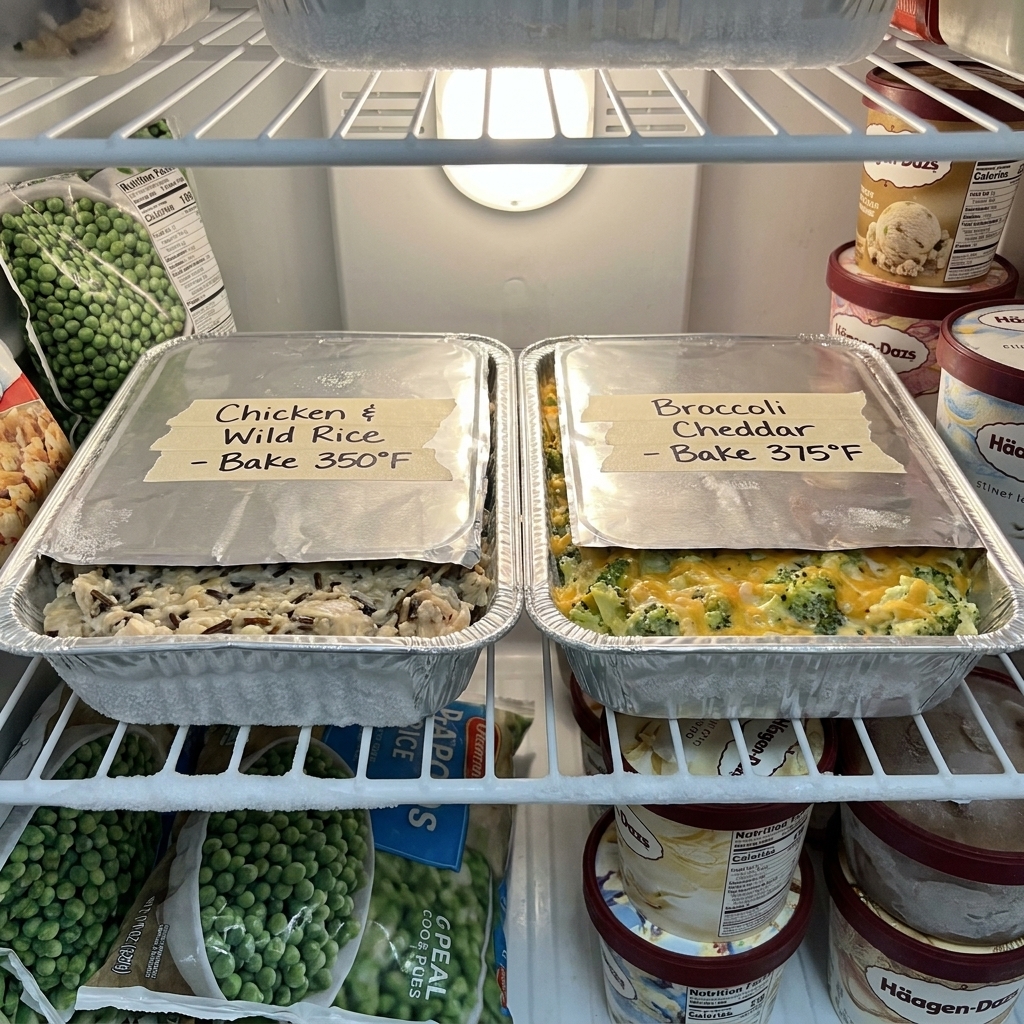
If you are the person bringing multiple dishes, consider making one casserole that bakes from frozen and one that reheats beautifully. That gives you flexibility if the host’s oven is already full.
My personal security blanket is keeping two emergency casseroles in the chest freezer at all times. If a potluck plan changes, I can still show up with something warm and hearty without turning my kitchen into a last-minute science experiment.
Quick FAQ
Can I stack casseroles?
I do not recommend stacking. You block heat and steam, and the bottom dish often ends up undercooked. If you are truly out of space, bake in shifts and use a holding method for finished dishes.
Do I need convection?
No. Convection helps with browning and speed, but you can absolutely do Oven Tetris in a standard oven. If you do use convection, consider dropping the temp by about 25°F and start checking early. Also keep an eye on exposed tops, because convection can over-brown fast. Foil tenting is your friend.
Is it okay if the temperature changes mid-bake?
Yes, within reason. Most casseroles are forgiving, especially when covered. The key is to avoid repeated temperature changes. One planned switch near the end is usually plenty.
Best tool for baking multiple casseroles?
A roll of heavy-duty foil. Tight covering prevents dry edges, buys you time during temperature compromises, and makes holding finished casseroles much easier.
One last pep talk
If your oven is full and your counter is covered in foil, you are doing it right. Pick a base temperature, protect your casseroles with foil, rotate once, and give yourself a holding window. Your goal is not perfection. Your goal is a table full of hot comfort food that makes people feel taken care of.